
AAC (Autoclaved Aerated Concrete) blocks are lightweight, precast building materials made by combining cement, lime, fly ash or sand, water, and a small amount of aluminum powder. When these ingredients are mixed, the aluminum reacts with lime to produce hydrogen gas, creating millions of tiny air bubbles within the mixture. Once the gas escapes, the mixture solidifies into a porous but strong structure. This gives AAC blocks their characteristic light weight, high insulation, and excellent strength-to-weight ratio, making them ideal for modern construction.
AAC blocks offer several advantages over conventional clay bricks. They are up to four times lighter, which reduces the overall dead load on a building and helps speed up construction. Their superior thermal insulation keeps interiors cooler in summer and warmer in winter, lowering energy costs. They also provide better sound insulation and are more fire resistant, withstanding heat for up to six hours compared to about two hours for clay bricks. Because of their uniform shape and larger size, they require less mortar and result in faster, cleaner masonry work. Additionally, AAC blocks are eco-friendly since they use industrial waste like fly ash and do not consume natural clay or topsoil, making them a sustainable building material.
The manufacturing process of AAC blocks involves several precise steps. First, raw materials such as fly ash (or sand), cement, lime, gypsum, water, and aluminum powder are measured and mixed into a slurry. The aluminum powder reacts with lime, generating hydrogen gas that causes the mixture to expand and form a semi-solid “cake” filled with microscopic air pockets. This expanded mass is then cut into required block sizes using automated cutting machines. The green (uncured) blocks are next placed in an autoclave — a high-pressure steam chamber — where they are cured at around 180°C and 12 bar pressure. This autoclaving process strengthens the blocks and gives them their lightweight, durable, and thermally insulating properties. After curing, the blocks are cooled, tested for quality, and packed for shipment.
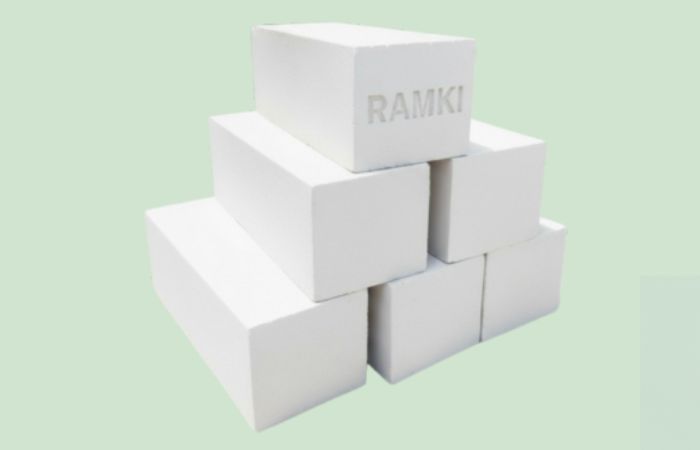
AAC Blocks are a smart alternative to traditional clay bricks. They are lightweight, highly durable, and provide excellent thermal insulation. Ideal for all types of construction, our blocks help reduce structural load, speed up construction, and lower overall building costs.
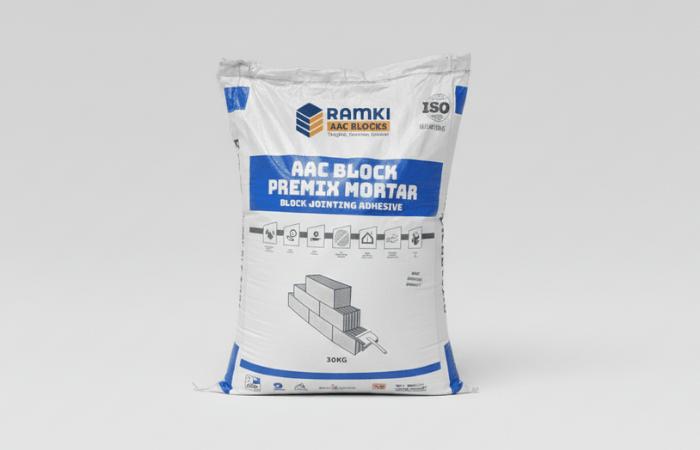
Ramki BOND is a high-performance thin jointing mortar formulated with advanced polymer additives. It provides strong mechanical bonding between AAC blocks, superior adhesion, minimal material wastage, and faster application compared to conventional cement mortar.



| S.No | Feature | AAC Blocks | Traditional Bricks |
|---|---|---|---|
| 1 | Weight | Light | Heavy |
| 2 | Size | Larger | Smaller |
| 3 | Speed of Construction | Fast | Slow |
| 4 | Thermal Insulation | Excellent | Poor |
| 5 | Eco-Friendliness | High | Low |
| 6 | Water Absorption | Moderate | High |
| 600mm x 200mm x 50mm |
| 600mm x 200mm x 100mm |
| 600mm x 200mm x 150mm |
| 600mm x 200mm x 200mm |
| 600mm x 200mm x 225mm |

At Ramki AAC Blocks, we are redefining modern construction with eco-friendly, high performance building materials. Established with a vision to create smarter and greener.